Wednesday, February 27, 2013

Paz and Brown

"Love is an attempt to penetrate another being, but it can only be realized if the surrender is mutual. It is always difficult to give oneself up; few persons anywhere ever succeed in doing so, and even fewer transcend the possessive stage to know what love actually is: a perpetual discovery, an immersion in the waters of reality, and an unending re-creation." (Paz, Octavio. "Mexican Masks" The Labyrinth of Solitude, 42.)

        In "Mexican Masks," Octavio Paz argues that Mexicans of all classes and ages present a mask to the world rather than their true self. Mexico is a hostile environment that obliges the people to close themselves off. Based on their history, this reaction is justifiable. But, rather than embracing and refining solitude in a healthy way, Paz suggests that the effect of solitude is manifest in extreme defensiveness and aggression, bravado in "machismo," and paralyzing shyness that often offends. Distrust, irony, and suspicion replace patience and long-suffering as a result of the people’s solitude.

          “Mexican Masks” reminded me of Brene Brown's presentation on TED Talks. Brown sought to discover the key to human connection.  After 6 years of research, her conclusion was that, "in order for connection to happen, we have to allow ourselves to be seen. Really seen." People who experience love and belonging have the courage to be imperfect by letting go of who they ought to be and allowing themselves to be who they really are. To borrow Paz's analogy, people who experience love and belonging are able to because they have taken off their masks. Although vulnerability is at the core of shame, which causes self-consciousness and defensiveness and thereby prevents connection, vulnerability is also the birthplace of love and belonging. This is because it is when we allow ourselves to be vulnerable we open ourselves up to love. Being authentic, letting ourselves be seen, taking off our masks is how we begin to develop healthy, loving relationships.

         The mutual surrender Paz describes as necessary to realize love is the embracing of vulnerability that Brown discovered. The “Mexican Mask” is the image of what one ought to be that we must let go of in order to allow ourselves to be who we really are. There is no vulnerability in solitude, no giving oneself up, which is why “few persons anywhere...know what love actually is.” Paz and Brown recognize the solution to the “hermeticism” of the Mexican people as surrendering our pride and allowing others to see our true selves. 


(Turn the video on and listen to it while you're getting ready for school in the morning or something. It's 20 minutes, and definitely worth it)

Wednesday, February 20, 2013

Book Making and Candido

"The meeting occurred at a dance: it was--to recall the young man's former trade--the first page of that book, which was to leave the press badly printed and with a worse binding. " (Machado de Assis, "Father vs. Mother") 
       At it's outset, "Father vs. Mother" is a story of desperation feeding on itself. Candido Neves and his wife Clara are forced to leave their baby at a convent. When Candido captures a slave who is pregnant, and terrified of being hurt, he is put to the test. Will Candido place the needs of her unborn baby before his own family's? In a few sarcastic lines, we realize the story's dark conclusion. Because of the above quote, however, I believe that this was not intended to be a tale of desperation, but a tale of poor judgement, planning and work ethic, based on my experience with book binding.

          According to the metaphor highlighted in the above quote, Clara and Candido's relationship is a book.  Each encounter between the two makes up the pages-- every experience adds to the story. The "binding" is what keeps them together--couples are bound by love and commitment, books are bound by thread and/or glue. Bad binding indicates poor technique, that the job was rushed.  Based on Candido's lack of self discipline and commitment in learning the printing industry earlier, ("He began by deciding to learn printing but he soon saw that it would take some time to become a good compositor, and, even so, most likely he would not earn enough. That is what be told himself..." [Machado de Assis, "Father vs. Mother']) it comes as no surprise that his attempt at marriage would be equally weak, and assumptions beforehand just as rushed and unfounded. As far as being "badly printed," clearly Machado is referring to the lack of foresight and judgement that went into this relationship. If the printing is bad, it means that the printer did not take into account details as he plowed ahead. Such is the case with Candido and Clara.

            To some extent, "Father vs. Mother" is a story of the dreadful ends of desperation. But because Machado compared Candido's marriage to both a poorly made book and his weak attempt at bookbinding, it is clear that Machado intended to show that Candido's situation was not an unfortunate inevitability. He created his reality, and as a result of poor planning, commitment, and foresight, things ended tragically. Innocent parties outside his immediate circle of influence were affected. Tragedy seemed unavoidable, but rather than taking responsibility for his own poor book making, he forced the consequences upon a woman and her unborn child. No, a poorly made book is not a tragedy or even a crime, but it is a waste. Candido rushed into creating a family without having the self discipline, wisdom, or work ethic to properly support them, and as a result he lost his opportunity to have created a book of value, a book that did not have to rely on unethical justifications for its weak resolution.

Wednesday, February 13, 2013

What Makes Iracema and Martim Human

"Iracema is more strongly attached to Martim than he is to her. Martim's inability to maintain his interest in Iracema soon sends her into a fatal decline from unrequited love."  Naomi Lindstrom (Foreword to Iracema, xvii.)
          Iracema and Martim's love story is pretty fantastic, verging on cliche. However, I think that the psychological realism of their story allows the reader to suspend their disbelief. Though tragic, Iracema and Martim's actions are not only believable, but consistent with Viktor Frankl's "will-to-meaning" theory.

Martim is dissatisfaction results in Iracema's abandonment 
             According to Frankl, an individual's primary motivational force is to find a purpose in life. Frankl suggests that one of the ways we can discover meaning in life is by experiencing or encountering someone. For Iracema, encountering Martim gave her life meaning. The subsequent failure of that relationship causes her to lose that essential what gave her life meaning and helped her feel fulfilled. Because Iracema does not replace what gave her purpose with something equally fulfilling, Iracema remains empty. The "spiritual" aspect of her being, as Frankl would describe it, starves and leads her to experience symptoms of depression (as manifest by her jealousy, loss of desire to live, and lack of motivation/belief that she can change her situation). Iracema's experience with Martim is consistent with Frankl's description of people who have experienced and then subsequently  lost their sense of meaning. Leave that need unfulfilled leads to a deep sense of loss. Martim's unfulfilled need for a purpose is apparent in his restlessness, "While Iracema frolicked along the beach, the warrior’s eyes turned from her to gaze upon the sea’s immensity."(Jose de Alencar, Iracema, 84) Although he could find happiness and fulfillment in his relationship with Iracema, he seeks fulfillment by other means which leads him to abandon her.

         Both Martim and Iracema demonstrate that man truly desires purpose. Instead of investing her time and efforts into some other cause or even trying to improve things with Martim, Iracema instead becomes depressed and even suicidal. Martim, rather than being satsified in his relationship with his wife, remains discontent, constantly searching for meaning and clinging to things of the past.  However fanciful this story of a beautiful Indian princess seducing a brave European warrior is, however exotic and mystical, there is undeniable humanity in Iracema and Martim. Frankl suggests that it is our spirituality that makes us human. It is the apparent desire for meaning in both of these characters, driven by the spiritual aspect of their individual beings, that makes these characters both believable and their experiences tragic. 

Wednesday, February 6, 2013

Foreigner + Native


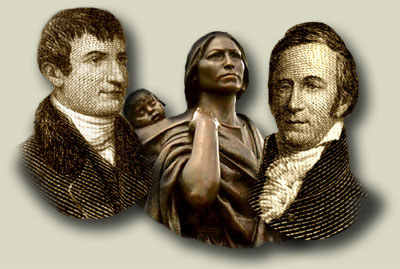
Lewis and Clark Monument in my hometown.
 "If Iracema is America, Martim is the European military man who takes over the land."  Alencar, Iracema, xviii
        For the U.S., our most famous "Foreigner meets Native" is the story of Lewis and Clark and Sacajawea. Minus the romance, the story of Lewis and Clark is very similar to Iracema's, told from the opposite perspective.

        Alencar tells the story of Iracema from the view of a native. Iracema is naive, misguided, and somewhat of a traitor. Her life is tragic, her love doomed. She changed the course of her nation's history by welcoming a foreigner. Sacajawea's story is told from the perspective of the foreigner. Sacajawea is a hero! A strong woman, both smart and selfless. She changed the course of our nation's history by facilitating the expansion of the U.S.! 

              Martim, while characterized as being civilized, sensitive, and willing to learn the native culture, he is "the military man who takes over the land." Lewis and Clark, however, are the wise, courageous, claimers of new territory. They are brilliant symbols of the American dream, of exploration and discovery. 

               Just as Dr. Mack said that most of the attention is given to Iracema in this book, most of our attention, as Americans, focuses on Lewis and Clark (notice that in the above memorial Sacajawea is not represented). Martim's story is significant because of Iracema. Sacajawea's story is significant because of Lewis and Clark.
         
      The above quote states that Iracema is America, and it is clear that Sacajawea fits the same role. The difference between the stories is that Martim is "the military man who takes over the land, " but Lewis and Clark are the heroes that discovered the land.  

Would the story of Iracema, told with emphasis on Martim's experience become Lewis and Clark + Sacajawea? Does the difference between the way these similar stories are told tell us something about the attitudes and perceptions of their respective nations?

I think so.

Wednesday, January 30, 2013

Altamirano's Self-Deception

Though I knew that everywhere in Europe, states were tearing at the authority of the Church, and though I well knew that to preserve itself there, the Church must show its authority over the Jesuits here, I still couldn't help wondering whether these Indians would have not have preferred that the sea and wind had not brought any of us to them. (The Mission.)
This was a statement made by Altamirano as he was visiting Father Gabriel's remote mission of San Carlos. In this scene, it was clear Altamarino was deeply affected by the simple and faithful lives of the Guarani, he was coming to see the truth in Father Gabriel's words that these truly were "naturally spiritual people."

That being said, was this statement Altamirano's way of foreshadowing the horrific events to come? Perhaps, but it seems to be more than that. It's not a statement made for the sake of the viewers, but for his own as well. This is Altamirano's attempt at justifying his role in causing what he knows is about to be depicted. This is, after all, very much Altamirano's memoir.  Altamirano knows that he will inevitably cause the destruction of this Mission and the faithful people there, and is justifying his actions by basically saying, "The Guarani were doomed long before I was sent, they were doomed when the wind and the sea blew the first Spanish settlers here." (Let us also note that the Spanish/Portuguese settlers are not faulted, but the wind and the sea that sent them.)

So what is the point of all this? To blame Altamirano, point out that he tried to cast fault for the slaughter of hundreds/thousands onto the weather? Not necessarily. Just as Pilot used a symbolic washing of the hands to distance himself from Christ's crucifixion, Altamirano uses fate/nature to do the same for himself. Yes, we can all agree that it would have been better for the Guarani to have lived untouched by European settlers. Given that that was not the case, their well-being should not have been disregarded and assumed to be beyond defending, as it seems Altamirano wants us to believe. For the Guarani, living in the Mission was certainly better than slavery or indentured servitude, and absolutely better than death.

Altamirano was correct in his assertion that it would have been better for the Guarani if the Europeans had never come, but he was wrong if he thought that was justification for forcing them out of their territory and allowing them to be murdered. Confronted by a decision between power and conscience, Altamirano ultimately chooses power, and when filled with regret, seems to look back on his actions and say, "I would not be guilty if this situation had never come about in the first place."

Wednesday, January 23, 2013

Truth Takes the Road Between them Both

"My faith has never failed me, but my relationship with God has been changing with the years. Sometimes, not thinking, I call him Negenechen, and I confuse the Virgen del Socorro with the blessed Mother Earth of the Mapuche--I am no less a Catholic than before, God fordbid!" Ines of My Soul, pg 208

A diagram of The Seven Sacraments, our way to Salvation 

  I just wanted to dissect Ines' approach to Christianity at this point-- because she seems to be dabbling into some non-Catholic Doctrine here which I find very interesting considering the timeframe (the Protestant Reformation going on in Europe around this time). 

    Christianity can be divided into two basic segments based on the doctrinal approach to Salvation. One segment of Christianity believes that we are "reborn" to things of God and receive salvation by receiving the sacraments of the Church. This segment is usually associated with Catholicism. In The Catechism of the Catholic Church, the sacraments are defined as "efficacious signs of grace, instituted by Christ and entrusted to the Church, by which divine life is dispensed to us. The visible rites by which the sacraments are celebrated signify and make present the graces proper to each sacrament. They bear fruit in those who receive them with the required dispositions." 

Protestant approach to Salvation
       The second segment of Christianity (usually associated with Protestantism) believes that our spiritual rebirth consists of having a personal experience/relationship with Jesus. The belief that we are born again spiritually by achieving this personal relationship with Deity was a product of the Reformation. 

       Where does Mormonism stand? Joseph Smith, as he so often did, said that truth takes the road between them both. On page 162 in Teachings of the Prophet Joseph Smith we read, "Being born again comes by the Spirit of God through Ordinances."

          In Chile, Ines is having a tremendously spiritual experience. She is learning to rely on her faith, having a "rebirth" to things of a spiritual nature. It makes sense to me that she would turn towards Mapuche tradition to realize a personal relationship with Deity, even though such a closeness is not emphasized in the Catholic church. She is both the type of person who would and in an environment where she can explore religion and find what really brings her peace. The fact that other men and women were searching for the same thing at this time makes historical sense, too. Ines had her own personal Reformation in South America. 

          Because we know by modern revelation that having a relationship with God (or as we would say, "receiving the Spirit") is just as essential as receiving ordinances, it makes sense that Ines would hunger for more than just what Catholicism offers. She continues faithful to the Catholic church while adopting the "relationship with God" characteristic of the Mapuche. Her spiritual development is not limited to the Seven Sacraments, which is exemplified by this quote.

Wednesday, January 16, 2013

Narcissus

"Solitude is a distinctive characteristic of adolescence. Narcissus, the solitary, is the very image of the adolescent. It is during this period that we become aware of our singularity for the first time. But the dialectic of emotions intervenes once more: since adolescence is extreme self-consciousness,  it can only be transcended by self-forgetfulness, by self-surrender. Therefore solitude is not only a time of solitude but also of great romances, of heroism and sacrifice." Paz, pg. 203
Ayrton on Christmas morning!

      I want to address Paz's idea that Narcissus is the very image of the adolescent. To the right is a picture of my cousin, Ayrton. He has NPD, Narcissistic Personality Disorder.  I learned a lot about the pathological form of narcissism when he lived with me and my family!

       All people can have Narcissistic or selfish tendencies. Paz associated narcissism with adolescence, which is true for most people. For those with NPD, near the end of adolescence is when they first start getting diagnosed. Some of the easiest symptoms of Narcissism to recognize are extremely fragile self confidence; an excessive need for validation, attention, admiration, etc.; experiencing feelings of rejection too easily; and acting unemotional or "tough" most of the time.

      Also, in Ayrton's case, he can only understand people as objects. For example, if you kick an object, it will still work the next day. If you kick a person, they are going to act differently around you as a result. For some reason Ayrton does not make those connections. In Levinas' terms, Ayrton sees all people in their most finite.

       A lot of times he will do what normal people would consider "mean" things (never out of meanness, always out of self-gratification) and then act like nothing happened later. It's kind of endearing at first but then it becomes exhausting.

       The point is that Ayrton, as an extreme case, totally supports Paz. If we, as narcissists in our adolescence, heal ourselves and our solitude by looking outside ourselves to see others and their needs, we truly are heroes! I mean, if Ayrton was finally able to do that by overcoming the the wall that prevents him from seeing others, he would be my hero. Knowing Ayrton it is easy to see that by embracing Levinas' ideas (that we indeed are our brothers' keepers, and that humans are infinite beings), we can heal the pains of our own solitude, reverse our narcissistic tendencies, and achieve the great "romances, heroism, and sacrifice," described by Paz.